
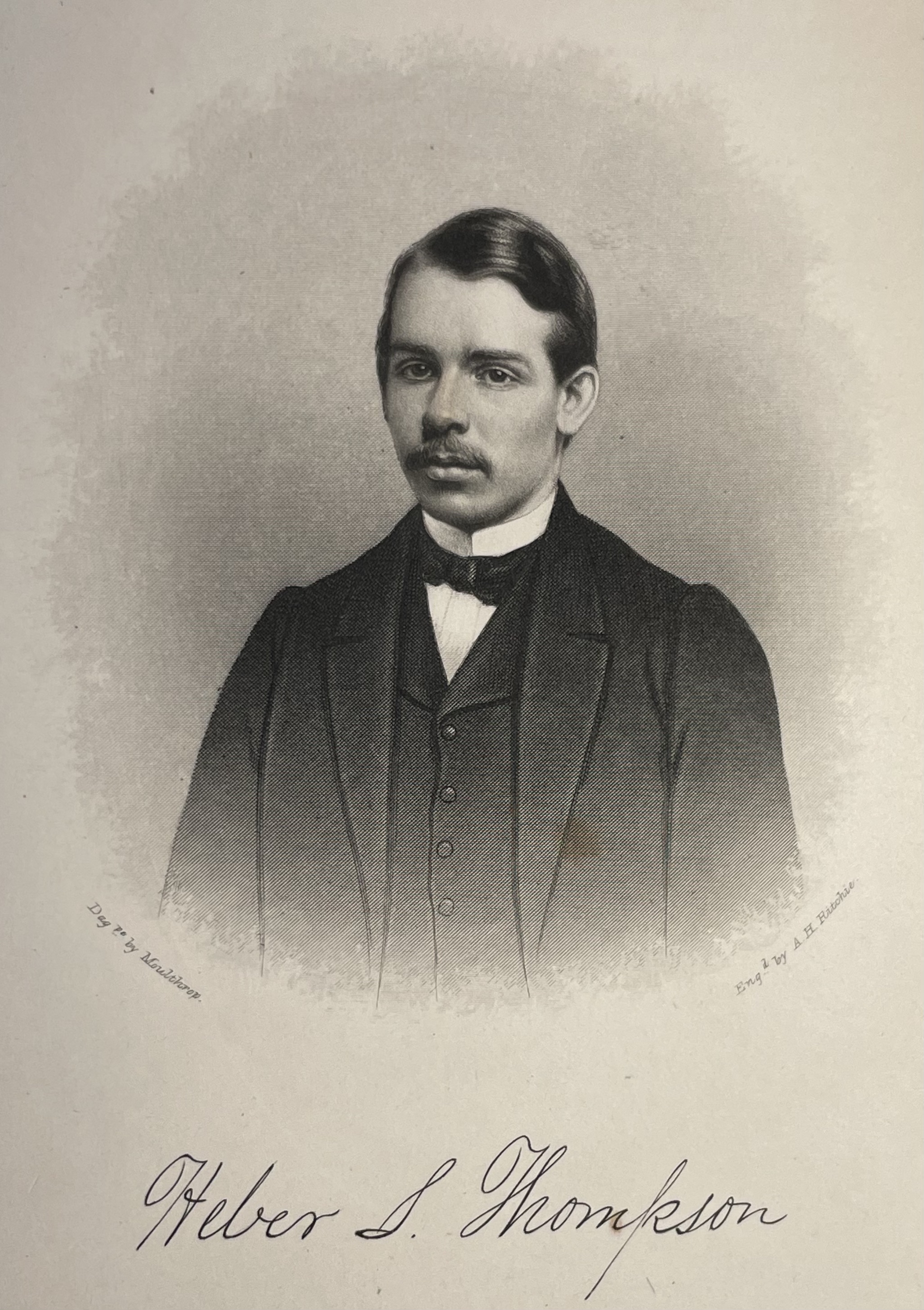

Every Memorial Day, Americans pause to remember those who served and sacrificed for the nation. For me, this year’s reflection returns to a group of young Yale students whose lives became intertwined with one of the most defining moments in American history.
Last year, I wrote about the men featured in the Heber S. Thompson Collection at the Abraham Lincoln Presidential Library and Museum. The collection documents the experiences of the first Yale student known to answer President Abraham Lincoln’s call for volunteers after Fort Sumter.
What has stayed with me most are not simply the historical milestones, but the ages of the men involved.
They were college students.

In April 1861, Heber S. Thompson was a Yale senior preparing for graduation when news of Fort Sumter reached the country. Within days, he left home in Pottsville, Pennsylvania, enlisted in the Washington Artillerists, and traveled toward Washington as part of the Pennsylvania volunteers later remembered as the “First Defenders.”
Many of his classmates would follow.
The Yale Class of 1861 ultimately saw classmates serve on both sides of the Civil War. Some wore Union blue. Others later joined Confederate forces. Yet within Thompson’s surviving papers are reminders that, before the divisions of war fully hardened, these young men still shared classrooms, friendships, literary societies, and aspirations for the future.

One document in the collection especially moves me: a petition signed by Thompson’s classmates asking Yale to award him his degree after he rushed to defend Washington. Remarkably, some of the signatures are from classmates who would later fight for the Confederacy.
It is easy to view the Civil War through monuments, casualty numbers, and famous speeches. Memorial Day reminds us instead to think about individual people.
Young men who had barely begun adulthood.
Students who traded lecture halls for train depots and rifle lines.
Classmates who suddenly found themselves on opposite sides of history.

Thompson traveled to Washington in the same regiment as Nicholas Biddle, the African-American orderly wounded during the Pennsylvania volunteers’ passage through Baltimore in April 1861 — among the first bloodshed associated with the Civil War. The collection captures not only military history, but the deeply human uncertainty of the war’s opening days.
These themes became central to my recent Manuscript Mondays presentation for the Manuscript Society titled, “First to Answer Lincoln’s Call, Rejected by Yale: Heber S. Thompson and the Power of Manuscripts”, where I discussed how original manuscripts preserve not only historical events, but the personal humanity behind them. (Manuscript Society presentation YouTube)
I also previously explored Thompson’s remarkable story in another essay, “First Yale Student to Answer Lincoln’s Call”, including his unusual relationship with Yale and the enduring historical importance of his papers. (ProtectingSight blog post)

As I reflect on Memorial Day, I also think about how fragile historical memory can be. Manuscripts, letters, albums, and diaries preserve moments that otherwise disappear. They remind us that those we commemorate were not abstractions. They were students, sons, classmates, and friends.
The men of Yale’s Class of 1861 could not have imagined how history would remember their generation. Yet more than 160 years later, their writings still speak.
And perhaps that is part of Memorial Day’s purpose: not simply to honor sacrifice in the abstract, but to remember individual lives — interrupted, transformed, and, in many cases, lost in service to the nation.
Before they were soldiers, they were simply young men with futures ahead of them.
Abraham Lincoln Presidential Library and Museum
Ravi D. Goel Collection of Heber S. Thompson. Abraham Lincoln Presidential Library and Museum. The Ravi D. Goel Collection of Heber S. Thompson highlights the Civil War experiences of the first Yale College student to answer President Lincoln’s call for volunteers after the Battle of Fort Sumter. Heber S. Thompson, a member and author of The First Defenders, enlisted in the Civil War on April 17, 1861. The collection includes a handwritten note from Yale Professor (later 11th President) Noah Porter advising Thompson to, “ask a furlough” in order to return to Yale for final exams. Also includes a letter signed by senior classmates, including Confederates, who state Thompson was, “among the very first to hasten to Washington for the defence of the National Capitol” and petition “the Faculty to admit him to the honors of graduation with his class.” Thompson’s Class of 1861 album is filled with personal entries and connections to fellow students, many of whom served on both sides of the Civil War. These materials provide unique insights into Thompson’s life, his contributions to the Union Army, and the broader context of early Civil War history. (Donated December 2024; Lincoln Presidential Library finding aid | Lincoln Presidential Library blog post | ProtectingSight blog post | Manuscript Society presentation YouTube) (#17, 2024)
Ravi D. Goel, MD collects historical documents as a hobby. He has donated manuscripts and collections to the Abraham Lincoln Presidential Library, Amherst College, Dickinson College, Forest History Society, Harvard University, Minnesota Historical Society, Princeton University, Yale University, and YIVO Institute. Collection highlights are described here.
