
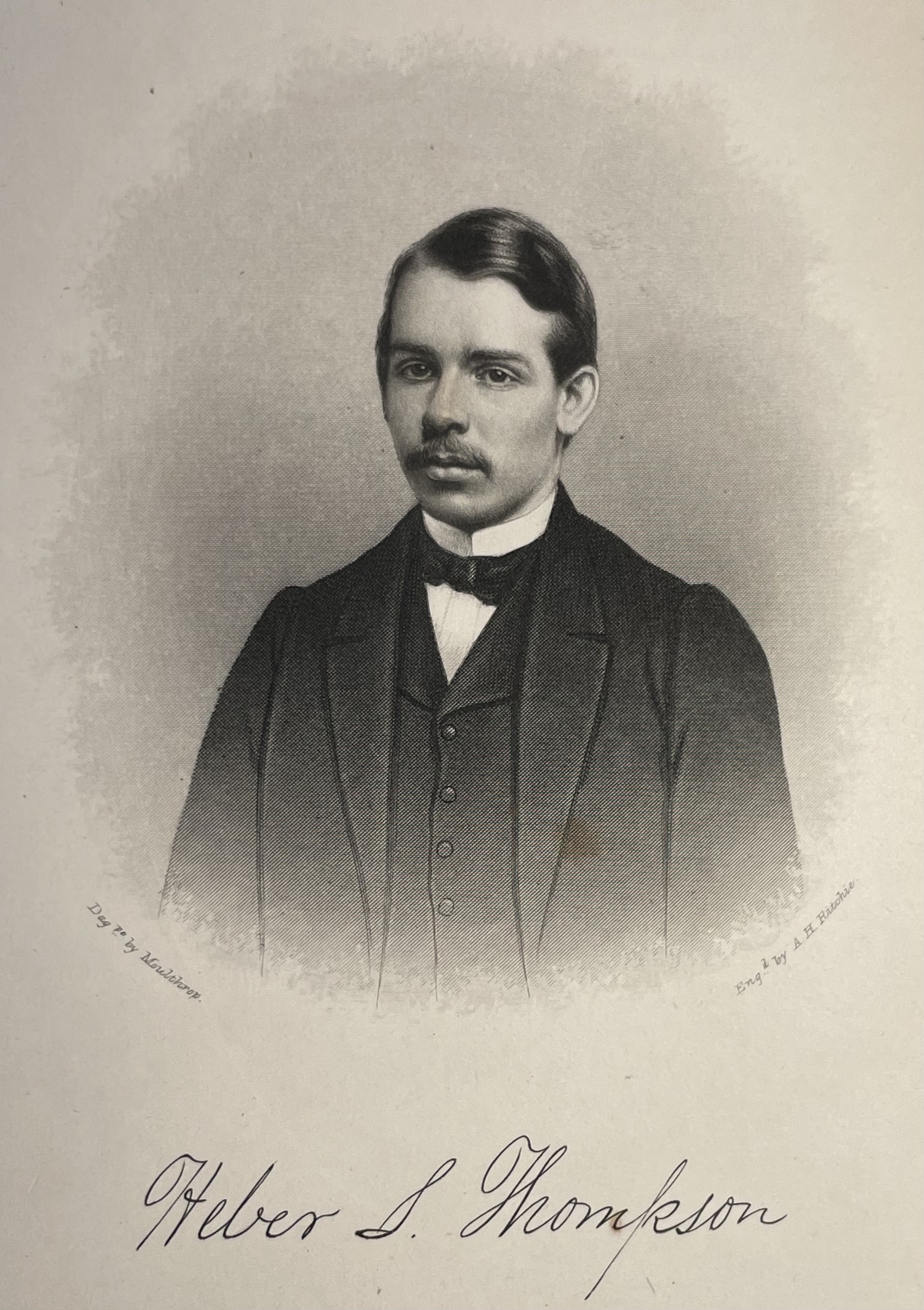

The Ravi D. Goel Collection of Heber S. Thompson highlights the Civil War experiences of the first Yale College student to answer President Lincoln’s call for volunteers after the Battle of Fort Sumter.
In April 1861, Heber S. Thompson was a Yale senior and on vacation at his home in Pottsville, Pennsylvania. The Yale College Second Term ended on April 9th, 1861, and the Third Term was to begin on May 1, 1861. Shortly after the bloodless Battle of Fort Sumter on April 12-13, 1861, President Lincoln issued a proclamation on April 15, 1861, calling for 75,000 volunteers to defend the United States.

Map of the Baltimore and Ohio Rail Road 1878
Thompson left his home and enlisted as a private in the Washington Artillerists of Pottsville on April 17, 1861. In the early hours of April 18, 1861, the Pennsylvania companies mustered into the service of the United States and traveled from Harrisburg to Baltimore, where they marched two miles to the next train station.

During this march through Baltimore, the first bloodshed of the Civil War occurred when Nicholas Biddle, an orderly to Washington Artillerists commanding officer Captain James Wren, “received a severe cut on the head, and it was said one of the soldiers was injured,” during clashes with local residents. (Baltimore Sun article) John Hoptak writes, “For the idealistic volunteers from Pottsville, Allentown, Reading, and Lewistown, it was a trying ordeal and one that diminished the romanticized notion of the glories of soldiering. Soon, all the men were boarded and the train sped south toward Washington.” (Hoptak, Pennsylvania Gazette, Spring 2010)

The Pennsylvania companies traveled through Baltimore one day before the Baltimore Riot of April 19, 1861. The confrontations between pro-Southern sympathizers and Union troops (Pennsylvania and Massachusetts state militia regiments) traveling through Baltimore exposed the deep divisions within the city and the nation.
The Pennsylvania companies arrived at the U.S. Capitol around 6 pm on April 18, 1861. Heber S. Thompson and his fellow Pennsylvania volunteers became known as The First Defenders. Thompson later served as president of the First Defenders Association and authored The First Defenders (1910).

The First Defenders marched to the Capitol basement to receive muskets, “Springfield rifles, accoutrements, and ammunition.” Thompson writes, “The President of the United States, Abraham Lincoln; the Secretary of State, William H. Seward, and the Secretary of War, Simon Cameron, were present during this distribution of arms, and Abraham Lincoln, passing down the lines as they were drawn up to receive the new rifles, shook hands with all the members of the companies.” (Thompson, First Defenders, page 14-15).
The Ravi D. Goel Collection of Heber S. Thompson includes a handwritten note from Yale professor (later 11th president) Noah Porter, dated June 4, 1861, advising Thompson to “ask a furlough” to return to Yale for his final exams. Porter writes, “The Faculty fully appreciates the circumstances with which you volunteered + the motives which induced you without hesitation to proceed at once for the defence of the Capitol. The examination will not be scored.” (Item #1)

(NY Times, June 21, 1861)
On Presentation Day, June 19, 1861, the Senior Class voted to petition the Faculty on Thompson’s behalf. The Goel collection includes a letter signed by his senior classmates, including some who were Confederates, who affirm that Thompson was “among the very first to hasten to Washington for the defence of the National Capitol” and petition “the Faculty to admit him to the honors of graduation with his class.” A class leader sent Thompson a copy of the petition, noting that classmates had signed the document “before finding that you were coming along.” (Item #2) It is unclear whether Yale possesses a copy of the original petition.
Thompson received a furlough to return to Yale for his final exams. He wrote, “Private Heber S. Thompson had been granted a furlough of ten days to go to New Haven, Conn., to take the biennial examinations of the Senior Class of Yale College, of which he was a member. He passed the examinations and was graduated with the class of 1861, though on Commencement Day he was on duty with his Company at Fort Washington, Maryland.” According to Sergeant Valentine Stichter’s diary, Thompson returned to his regiment on July 2, 1861. His classmates celebrated Yale Commencement on July 25, 1861. (First Defenders, p. 107).

Thompson’s Class of 1861 album is filled with personal entries and connections to fellow students. These materials provide unique insights into Thompson’s life, his contributions to the Union Army, and the broader context of early Civil War history. (Item #101)
The Class of 1861 includes ninety-seven graduates and at least thirty-nine graduates served on both sides of the Civil War. (See Yale Courant article) Seven members of the Yale Class of 1861 later became Confederate soldiers. Remarkably, all six who graduated appear in the album and two are among the signers of the student petition to award Heber S. Thompson his Yale degree. Three of the six Confederate graduates were members of a Yale secret society (two Bones and one Keys).
In sharing the Heber S. Thompson Papers, I first approached the Yale Library, recognizing their commitment to preserving materials of historical significance. While they expressed appreciation for the offer, recent changes in their archival stewardship model have limited their ability to accept new collections, including some that are highly relevant to their holdings. I am grateful for their thoughtful consideration and guidance in exploring alternative repositories.
In February 2023, I offered these papers to the Abraham Lincoln Presidential Library and Museum (ALPLM) in Springfield, Illinois. Ian Patrick Hunt PhD, Chief of Acquisitions and Special Projects, writes, “We would be interested in adding this material to our collection given the direct connection to Lincoln as well as Thompson being attended to by Dr. George Todd (President Lincoln’s brother-in-law) while a prisoner in South Carolina in 1864.”

The collection was donated to ALPLM in December 2024. Ian Hunt PhD states that the collection, “highlights a critical moment in our nation’s history when individuals from across the North refused to ignore or accept the South’s unprovoked attack on the United States military … I am sure that this work will help further our understanding of the motivations of the Civil War’s earliest volunteers and their long record of service during that conflict.” (Lincoln Presidential Library finding aid)
In my discussions with Dr. Hunt, I inquired about the possibility of a private viewing of the Gettysburg Address — one of only five known copies in existence (Everett Copy). While the document is displayed publicly for two weeks each year to ensure its preservation, Dr. Hunt kindly assured me that the museum holds a wealth of other remarkable artifacts and offered to arrange a private exhibit featuring select items from their extensive collection. I deeply appreciated his generosity and was especially moved by the opportunity to see how the Heber S. Thompson Papers would be surrounded by other extraordinary materials that illuminate the earliest days of the Civil War and the individuals who answered the call to service during this defining moment in our nation’s history.
This blog post will be updated after the collection has been accessioned and the manuscript images have entered the public domain. I have included references, inventory, and a finding aid with notes below.

References
1. Thompson, Heber S. First Defenders. Reading, PA: First Defenders’ Association, 1910. (HathiTrust | Yale Orbis).
2. Diary of Capt. Heber S. Thompson. Seventh Pennsylvania volunteer cavalry Pottsville, Pa. May to December, 1864. (Original manuscript at South Carolina Library here | Yale Orbis) The finding aid states, “Dr. George R.C. Todd, brother-in-law of Abraham Lincoln served as a doctor at the facility and African American soldiers of the 54th Massachusetts Regiment were serving as nurses.” A University of South Carolina Report of Gifts (2007) states, “Dr. George Rogers Clark Todd (1825-1900), brother-in-law of Abraham Lincoln, is mentioned by Thompson, who indicated that the doctor was good to his Union patients whenever he was not drinking.” (USC Report of Gifts, page 121-22)

(NYTimes, July 22, 1861)
3. Based on a review of the Eliot and Hughes military histories, and the Yale Classes of 1861, 1862, 1863, and 1864 catalogues referenced below, Heber S. Thompson was the first student in Yale College to enlist (April 17, 1861) and muster (April 18, 1861) in the Civil War after the Battle of Fort Sumter (April 12-13, 1861).
The 2nd Yale Student to enlist was Walter Lowrie McClintock (Yale Class of 1862, Junior) – “McClintock’s army life was before graduation. He served at the outbreak of the war in a three months’ regiment, the Twelfth Pennsylvania. He was thus absent from college for the last term of Junior year, but returned in the fall.” (The Twenty Years’ Record of the Yale Class of 1862. United States: Press of John H. Bacon., 1884, link) According to PA Muster Rolls, McClintock’s Pittsburgh City Guards was mustered into service on April 25, 1861 as Company K of the Twelfth Regiment of Pennsylvania Volunteers during the early days of the American Civil War. (12th Regiment, Pennsylvania Volunteers, Company K, link)
The 3rd Yale Student to enlist was George Bliss Sanford (Yale Class of 1863, Sophomore) – “He left our Class at the end of the Freshman year, joining the Class of ’64, but at the breaking out of the war he again left college. He entered the United States regular army and was commissioned Second Lieutenant of the 1st Regiment of Dragoons April 26, 1861, serving in Missouri under Gen. Nathaniel Lyon in the Wilson Creek campaign.” (A History of the Class of 1863 Yale College, 1889, link)
The 4th Yale student to enlist was Sophomore Samuel Appleton (Yale Class of 1863, Sophomore), who enlisted on April 29, 1861. His 20th reunion profile states, “He left the Class during Sophomore year for the purpose of enlisting in the army. He remained in the service some three years, when he resigned on account of ill-health, having held the position of first lieutenant in the 12th Massachusetts Infantry, and captain on the staff of General Abercrombie.” (A History of the Class of 1863 Yale College, 1889, link)
The 5th Yale student might be William Augustus Kimball (Class of 1864, Freshman) – “left College for the seat of war in the 1st Connecticut Regiment, about the beginning of the third term, Freshman year ; returned with the regiment at the end of their three months’ term of service, and almost immediately afterwards obtained the position of Lieutenant in the Ira Harris Cavalry. He is believed to have returned from the war in safety, and to be residing in his native city.” (Beginning of the third term would be May 1861) (Class of 1864 Triennial – Triennial Meeting of the Class of 1864, Yale College, link)

(Frank Leslie’s illustrated newspaper February 2, 1861)
4. At least seven members of the Yale Class of 1861 became Confederates. All six who graduated appear in the album and two are among the signers of the student petition to award Heber S. Thompson (1861) his Yale degree. Three of the six Confederate graduates (50%) were members of a Yale secret society (2 Bonesmen and 1 Keys). The probability of an 1861 graduate being a member of one of the two senior societies was 31% (30 of 97).
Fielder Cross Slingluff (1861) – Signed petition, image in album
James Henry “Harry” Brent (1861) – Image in the album
Frederick Stanton “Fred” Davis (1861) – Image in the album
Edwin Lane Jones (1861) – Left Yale in 1858, no image
John Hanson Mitchell (1861) – Image in album wearing his Skull & Bones pin
Alexander Porter “Sandy” Root (1861) – Signed petition, image in album wearing his Skull & Bones pin
William Edward “Willie” Sims (1861) – Image in album wearing his Scroll & Key pin. Notable as CSA Brig. Adj Gen, captured, and later US Consul, Colon, 1890-1891.
5. Elmer, Walter F, and Baltimore And Ohio Railroad Company. Map of the Baltimore and Ohio Rail Road with its branches and connections, 1878. (link)
6. Nicholas Biddle Portrait. John L. Nau III Civil War History Collection, MSS 16459, Albert and Shirley Small Special Collections Library, University of Virginia. (link)
7. Massachusetts Militia Passing Through Baltimore (Baltimore Riot of 1861) engraving of F.F. Walker (1861) (link)
8. Inauguration of President Lincoln. U.S. Capitol dome under construction in background. Print on salted paper. March 4, 1861. Library of Congress CALL NUMBER: LOT 12251, v. 2. (Wikimedia)
9. “Passage of Northern Federal Troops” Baltimore Sun, April 19, 1861 (Baltimore Sun)
10. “The Literary Societies The Prize Debates The University Quarterly The War Spirit Wooden Spoon Presentation Day.” New York Times, June 21, 1861. (NY Times)
11. “Yale College Commencement Exercises.” New York Times, July 28, 1861. (NY Times)
12. Sheldon, W. D. (1864). Triennial Meeting of the Class of 1861, Yale College, With a Biographical Record and Statistics. United States: Tuttle, Morehouse & Taylor. (Google Books) Details of Thompson’s military service and capture. The profile states:
HEBER SAMUEL THOMPSON, (Pottsville, Pa., ) was born in Pottsville, Pa. , Aug. 14th, 1840, and entered the Class the second term, Freshman year. Though he was not with us during the last term of the course, being at the time in the army, he obtained a furlough, passed his examination, and received his degree with the Class. April 17th, 1861, four days after the fall of Sumpter, he enlisted as a private in the 25th Regt. Pa. Infantry, three months men, and was one of the very first to arrive for the defense of Washington. At the organization of the 7th Pa. Cavalry, he entered that Regiment as 1st Lieut. , Sept. 16th, 1861, and accompanied his Corps to Kentucky, there to form a part of what was then called the Army of the Ohio, under the command of Gen. Buell. In May, 1863, he was promoted to be Captain. He has participated in the battles of Chaplain Hills and Perryville, Ky.; Stone River and Murfreesboro, Tenn.; Chicamauga, Ga., and more than a hundred small fights and skirmishes. For some time past, he has been on duty as Acting Assistant Inspector, at the Headquarters 1st Brig., 2d Cav. Div., Army of the Cumberland. We understand he is engaged to be married, and is only detained from the happy consummation by a “military necessity.” He was captured while on one of Sherman’s grand Cavalry raids of the past Summer, and is still in the hands of the rebels. (bold added)
13. “The Class of 1861.” The Yale College Courant, vol. 1, no. 23, 12 Feb. 1868, p. 180. The Class of 1861 graduated 97 and 39 members of the class served in the army and navy during the war. “Sixteen entered the army as privates, eight of whom rose to a rank above second lieutenant before leaving the service. Two were killed in battle, two died by disease, one in a rebel prison; five were captured and seven wounded.” (JSTOR)
14. Decennial Record of the Class of 1861, Yale College, containing reports of Class Meetings, and a biographical sketch of each member. (1872). (Google Books) – Includes a detailed profile of Heber Samuel Thompson, including his own account of capture during the Civil War.
15. The Chattanooga Times published an article on November 16, 1897, covering the dedication of the 7th Pennsylvania Cavalry Monument on the Battlefield of Chickamauga Creek, Georgia, which took place on Monday, November 15, 1897. The article is referenced in a speech delivered that day by Heber S. Thompson (Yale 1861), but I have not been able to obtain a copy. I believe the Tennessee State Library may have one. (See Item #16 – Author: Heber S. Thompson, Captain, 7th Pennsylvania Cavalry, Chairman of Pottsville, Pennsylvania, Address.)
16. The fifieth anniversary of the class of 1861, Yale college, with biographical sketches (1912). Heber S. Thompson biographical sketch on pages 158-167. (Internet Archive)
17. “Heber Samuel Thompson (1840-1911)” – 7th Pennsylvania Cavalry profile here.
18. Major Heber S. Thompson Obituary, Mines and Minerals, May 1911, page 613. (Google Books)
19. Capt. Heber Samuel Thompson Find A Grave
20. Eliot, Ellsworth Jr. Yale in the Civil War. New Haven, Connecticut: Yale University Press, 1932.
21. Hughes, Nathaniel Cheairs. Yale’s Confederates: A Biographical Dictionary. Knoxville: University of Tennessee Press, 2008.
22. John David Hoptak. “Nick Biddle: A Forgotten Hero of the Civil War” (Pennsylvania Gazette, Spring 2010) link. The article states:
When the soldiers at last arrived at Camden Station, violence erupted. They were pelted with stones, bricks, bottles, and whatever else the vehement mob could find; some were even clubbed and knocked down by a few well-landed punches. A few more determined Confederate sympathizers lunged at the unarmed Pennsylvanians with knives and drawn pistols. “Powder had been sprinkled by the mob on the floor of the [railroad] cars,” wrote First Defender Heber S. Thompson (1840-1911), of Pottsville, “in the hope that a soldier carelessly striking a match in the darkened interior of the car might blow himself and his comrades to perdition.” (Thompson, who graduated from Yale in 1861, later served as president of the First Defenders’ Association and wrote The First Defenders, a history of the unit, published in 1910.) For the idealistic volunteers from Pottsville, Allentown, Reading, and Lewistown, it was a trying ordeal and one that diminished the romanticized notion of the glories of soldiering. Soon, all the men were boarded and the train sped south toward Washington.
23. John David Hoptak. “The Union’s Forgotten First Defenders.” Pennsylvania Legacies, vol. 13, no. 1-2, June 2013, pp. 4–15. JSTOR, www.jstor.org/stable/10.5215/pennlega.13.1-2.0004. Accessed 5 Feb. 2021.
24. The Heber S. Thompson Civil War Baseball Farewell Letters. “Historically vital series of letters has amazing baseball and Civil War content, and each is from a member of the Yale Base Ball Club. These letters are to Heber S. Thompson, who left the Yale Base Ball Club to enlist in Lincoln’s Army only scant days before graduation.” Lelands (2019)
25. The Twenty Years’ Record of the Yale Class of 1862. United States: Press of John H. Bacon., 1884. (Google Books)
26. A History of the Class of 1863 Yale College: From Ye Earliest Times. United States: n.p., 1889. (Google Books)
27. A History of the Class of 1863, Yale College: Being the Fourth of Those Printed by Order of the Class. United States: Tuttle, Morehouse & Taylor Company, 1905. (Google Books)
28. Class of 1864 Triennial – Triennial Meeting of the Class of 1864, Yale College: With the Biographical Record and Statistics. United States: n.p., 1868. (Google Books)

Finding Aid
Item #1 – Author: Yale Professor Noah Porter (Class of 1831, later Yale College 11th President 1871-1886)
Description: One June 4, 1861, Yale Professor Noah Porter writes to Heber S. Thompson asking him to request furlough in order to return to New Haven and take his examinations.
“The Faculy has directed me to write to you advising you to come on to New Haven if only for 3 or 4 days in order to pass some sort of an examination. If possible you had better ask a furlough. If you cannot obtain leave, you can come on as soon as your three months of service shall have expired.
The Faculty fully appreciates the circumstances with which you volunteered + the motives which induced you without hesitation to proceed at once for the defence of the Capitol. The examination will not be ?scored. Very truly, N. Porter”
Mesmerizing in every detail.
Landmark document. (*** Based on content, one of the best Yale letters I’ve ever come across. Plus the fact that this letter went from New Haven to the US Capitol to where Thompson was stationed in Maryland. And saved for 160+ years. )
Item #2 – Authors: Class of 1861 Petition to Yale President and Faculty
Description: “We humbly petition the Faculty to admit him to the honor of graduation with his class.” Petition signed by a Class Committee after Presentation Day. The classmates assumed that Thompson would not be able to return and pass his examinations. This copy was sent to Thompson as a sign of the remarkable regard which his classmates placed in him. Landmark document.
Item #3 – Author: Moulton Deforest (4/7/1839 – ). Enlisted 11/23/1861, as a private in the Eighteenth Regiment, Wisconsin Volunteers, and served for a time as Quartermaster Sergeant. Commissioned First Lieutenant September 1863. On staff of Division General, John. E. Smith. “He participated in the battles of Shiloh, Corinth, and in Grant’s brilliant campaign at Jackson, Miss.” With General Sherman in his march to the sea. Accompanied Sherman’s army to Washington.
Description: “I am sure that my personal regard for you was increased by every patriotic throb of my heart. I shall long remember you, Old fellow, as a noble hearted classmate and friend. But the brightest memory that clusters around your name will be of the time when I learned that in obedience to your country’s call you had rushed eagerly to her defence.”
Item #4 – Author: Walter Hanford (12/1/1840 – 4/26/1917). Scroll & Key secret society. Philosophical Oration appointments.
Description: Speaks of Sigma Delta (freshman) and Brothers (sophomore) societies. “The old society is dead now, defunct without any doubt.”
“But I have not room to mention all the incidents of our intercourse.”
“You have the honor of being the first man from ’61 to take up arms in your country’s defence; and the circumstances under which it was done do equal honor to your courage and patriotism.”
“You have been one of my best and truest friends in College and I am loth to think that we may never meet again.”
Item #5 – Author: William Henry Higbee (11/3/1839 – 9/21/1900). Acting Assistant Paymaster, US Navy. Attached to US gunboat during which many prizes were captured. Gave Oration, “Our Future” at Yale graduation as documented in NY Times 7/28/1861.
Description: “When I came back to college at the beginning of our last term I confidently expected to see you + to enjoy with you some more pleasant hours over the chess board + the whist table + in social intercourse in your room old ‘No. 7.’ But I was disappointed in all, for the news soon reached me that ‘Thompson had gone to the war.'”
“At first I was sorry to lose you, my dear fellow, but this feeling soon gave way to admiration for your patriotism + courage + I was also glad that old ’61 was not to left unrepresented in the glorious uprising for the defence of our national honor + integrity.”
“I most ardently hope that our paths in life may cross often + that I have by so means (?) seen the last of you.”
Superb letter. Heartfelt and with gratitude. Hopes to host Thompson when he passes through Trenton.
Item #6 – Author: John Coddington Kinney (1839-1891). “In Scribner’s Monthly June 1881, Kinney gives a graphic account for the Battle of Mobile Bay, fought by Admiral Farragut, August 5, 1864, one of the greatest sea fights of the Civil War.”
Description: Among the most poetic and detailed. 2 entries with similar sentiment. Refers to their intimate friendship, “as Freshman in the Halls of defunct Sigma Delta … now Mother Yale is turning us out of doors.”
“Your patriotism has deprived us of your company during the last and a very pleasant term, but I know you will never regret it.”
“I shall remember you as long as I remember the Class of ’61 or the Rebellion of ’61.”
*** 2nd sheet: “May He who fights on the side of Right-shield you – and bring you back unharmed to rejoice in treason crushed and slavery abolished”
Item #7 – Author: Oliver McClintock (10/20/1839 – 1922 ). 1st of many generations of McClintocks who attended Yale. “McClintock served with the rank of Corporal in Company D of the 15th Pennsylvania Emergency Militia, seeing active service at the two invasions of Pennsylvania by General Lee. At the battle of Antietam his regiment was rushed to the aid of General McClellan’s Army, but arrived too late to participate. At the time of Gettysburg, the regiment shared in constructing defenses for the city of Pittsburgh.” (Yale obituary)
Description: “how very prominent will be our reminiscences of the genial, full-hearted good-fellowship, which ever crowned our Junior year in Delta Kappa Epsilon.”
“sad parting of Presentation Day … I shall, though by piecemeal, live them all over again in dream life.”
“Admiring your noble patriotism in rushing among the first, to defend the Union, I wish, for your future, an earnest, faithful and successful life, in the highest and Christian sense of those words.”
Item #8 – Author: Edward Pascal McKinney (2/23/1838 – ) 6th New York Cavalry, Army of the Potomac, wounded 1864 in Virginia by guerillas. Discharged 1865 as Brevet-Major for meritorious services in the field.
Description: “I can’t let you go away without giving you some expression of the honor I have for your self sacrifice and patriotism in being the only one of the Senior class in 1861 to depart at your country’s call, regardless of your degree … this your crowning act shall ever mark you in my memory.”
“Think of old Yale and ’61, in the tiresome moments of camp life, and if you ever get a chance at the memory, strike one good blow in remembrance of Your true friend, Edward P McKinney”
Item #9 – Author: Stanford Newel (6/7/1839 – ). Yale Skull & Bones. US Minister to the Netherlands.
Description: “While most of us have been bidding one another a last farewell you have been “serving your country.” we can call ourselves the best of friends.”
Item #10 – Author: Joseph Lucien Shipley (3/21/1936 – 7/14/1911)
Description: “I shall remember you “Thomas” as a first rate fellow and firm friend and I shall remember you too with a kind of grateful veneration as the first man in Sixty One who responded to his country’s call. Blessings in your heart my Boy for so quickly downing the soldier’s clothes.”
Item #11 – Author: John Dresser Tucker (12/19/1838 – 12/3/1904)
Description: “Last Spring vacation, when I learned that you had gone with the first Pennsylvania Regiment of Volunteers in defence of our National Capitol, my admiration and respect for you grew mightily and I longed to grasp you by the hand and wish you a “God speed”. These are sad times we are living in now, and we can hardly tell what path we shall tread.” Ending one of inspiration, asking for “a Kind Providence preserve you.”
From a fellow fraternity brother (Delta Kappa Epsilon, same fraternity of both US Presidents Bush)
Item #12 – Author: John Curtis Tyler (2/18/1839 – 1/11/1880)
Description: “Your classmates will cherish the memory of the first volunteer, and among them, none will do with a warmer heart, than Your fine friend, Jno Curtis Tyler”
Item #13 – Author: George Worman (1832-1864) – Worman died as a prisoner of war at Cahawba, Ala. Died young and thus ultra-rare signature.
Description: “God help you and bring you back safely to your friends”
Item #14 – Author: Charles P. Otis (4/8/1840 – 12/17/1888). March 17, 1884 letter from Boston where Otis was MIT Professor of Modern Languages.
Description: “I can hardly realize that you have so large a family, and naturally envy you. But I am ready to forget that in my ’61 pride.” Both Thompson’s son and daughter are well situated at Andover.
Item #15 – Author: George Makepeace Towle
Description: Refers to Thompson’s daughter and niece at Andover. March 27, (?1884).
Item #16 – Author: Heber S. Thompson, Captain 7th Penna. Cavalry, Chairman of Pottsville, Penna. Address
Description: Dedication of the 7th Pennsylvania Cavalry Monument on the Battlefield of Chicamauga on the Ringgold Road near Reeds Bridge over Chicamauga Creek, Ga. on Monday November 15, 1897.
Address of Heber S. Thompson, Captain 7th Penna. Cavalry, Chairman of Pottsville, Penna.

Item #101 (Album)
Author: Faculty signatures
Description: Numerous faculty signatures:
Noah Porter (Yale 1831) – July 11, 1861
James Hadley – Sophocles quotation – July 7, 1861
H.A. Newton – July 15, 1861
Benjamin Silliman, Jr. – July 13, 1861
James D. Dana – July 13, 1861
Eleazar T. Fitch – July 15, 1861 – Hebrew writing which translates to “Wisdom shall first fear the LORD”
John S. Mills – July 11, 1861 – “Dulce et decorum est pro patria more” or “It is sweet and fitting to the native”
L.C. Chapin – July 11, 1861
***Portraits of each member of the Yale Class of 1861 with inscriptions of specific classmates named below.
Item #102 – Author: James Gardner Clark (12/25/1835 – 10/17/1905)
Description: “Yours, for the old flag”
Item #103 – Author: Franklin B. Dexter (9/11/1842 – 8/13/1920). Skull & Bones. Yale Secretary and Professor. The pre-eminent Yale historian. Has written almost all the biographies attached to this collection.
Description: “I feel the special circumstances under which we say Goodbye make my wishes for your safety and success so solemn that they are rather prayers.”
Item #104 – Author: James Wood McLane. Acting Assistant Surgeon during Gen. McClellan’s Peninsula campaign, 1862. Later President of Columbia College and Dean of Medical Faculty.
Description: Friends early and in DKE. “You sometimes disturbed my naps in — Sections”
“Good Luck go with you Old Boy.
Don’t get killed, doing your duty.”
The handwriting of a future physician!
Item #105 – Author: Nathan Tibbals Merwin (6/8/1836 – )
Description: “Instead of being here to enjoy the pleasures of our closing term you are undergoing the hardship of the camp(?) in the service of our common country. This in you is heroic, and has awakened not only in me but in all the members of Sixty One strong sympathies for you.”
Item #106 – Author: Stanford Newel clipping in New York Herald, Friday April 7, 1899
Description: Newspaper clipping which announces “the gentlemen selected by the President to represent the United Stats at the coming disarmament conference, to be held at the Hague.”
Includes Stanford Newel (Yale 1861, Skull & Bones), United States Minister to the Netherlands. Of note, this clipping also announces that the delegation will be led by Andrew D. White (Yale 1853, Skull & Bones, founding president Cornell), US Ambassador to Germany. So one cliping with 6 names announced include 2 members of Yale’s Skull & Bones.
The clipping is remarkable in that Thompson places this on top of Newell’s photo, thus giving proof that this album continued to be a part of his later life.
Item #107 – Author: Charles P. Otis (4/8/1840 – 12/17/1888)
Description: Detailed two page entry. “About this time you began to like (or dislike) what I was in the habit of thinking nobody ought to dislike – Yale Boating.” Nice references to Yale boating excursions.
“At the beginning of last term how did the feeling of surprise give way to that of admiration as we heard that the shining arms that pulled the oar and threw the baseball had not only accepted the volunteers lot, but had relinquished the concluding rewards of a College course. Noble fellow, Take our Class Oration and read that tribute of Six (?) to which the spirit of assent rose from the hearts of us beating with admiration and affections for you, as 61 for the last time filled them old Chapel seats.”
Item #108 – Author: Sextus Shearer, Jr. (10/14/1838 – 3/5/1869). Skull & Bones. Died young.
Description: “I don’t feel under any obligation to write to you again, for I wrote my autograph to you + spoke it too before quite an audience on Presentation Day.”
“You’ve got an honest heart, a clear hand, + a stout arm – + what more could one ask of Providence?”
Sincere admiration and friendship
Item #109 – Author: Theodore Stephen Wynkoop (11/22/1839 – 4/29/1923). Extraordinary career post-Yale. Served as a missionary in India. See his letters to the Class at the 50th reunion. “The war drums were beating when we said good-bye at Yale. How little we thought of the issues of the coming campaigns!”
Description: “How many gay old times we have had since we joined the class of ’61 and the glorious old Third Division!”
With special thanks
With special thanks to family, friends, colleagues, historians, Lincoln admirers, and others who generously shared their feedback, kind words, insights and encouragement. I am especially grateful to (in alphabetical order): Joshua Cochran, PhD; Jennifer Coggins, MS; Professor Gregory Downs, PhD; Professor Jay Gitlin, PhD; John Hoptak; Ian Patrick Hunt, PhD; Cary Hutto; Professor Brian Matthew Jordan, PhD; Jim Lawrence; Carly T. Lough, MLIS; Mathew MacCumber, MD, PhD; Dan Pickett; David Richards; Greg Skuta, MD; Robert Snyder; and my family. Notably, my brother Alok Goel, a devoted Lincoln admirer since childhood, encouraged me to add Lincoln to my collecting interests.

Ravi D. Goel, MD collects historical documents as a hobby. He has donated manuscripts and collections to the Abraham Lincoln Presidential Library, Amherst College, Dickinson College, Forest History Society, Harvard University, Minnesota Historical Society, Princeton University, Yale University, and YIVO Institute. The Goel collections were recently profiled in The Ophthalmologist, The Wills Eye Alumni Society Newsletter (pdf), and Yale Reunion Giving Volunteer Newsletter (blog post). Collection highlights are described here.
Dr. Goel’s efforts highlight the importance of preserving history to foster understanding and connection across generations. Through curating and donating these materials, he enhances their accessibility for scholars, researchers, and the public, ensuring their lasting relevance and impact.


2 Comments